
Their story
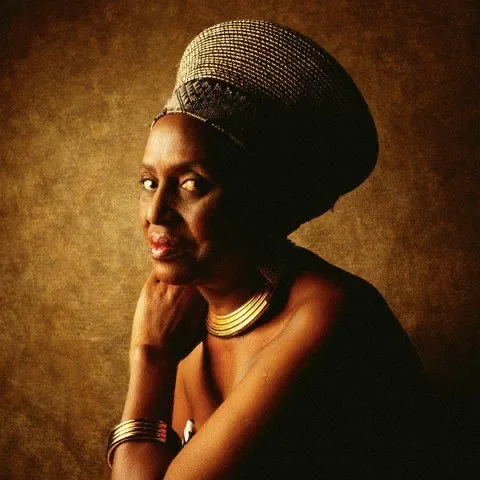
Nicknamed "Mama Africa," Miriam Makeba remains one of the greatest figures in African music and the fight against apartheid. For more than thirty years in exile, her voice carried a message of freedom, justice, peace, and unity far beyond the borders of South Africa.
Born Zenzile Makeba Qgwashu Nguvama on March 4, 1932, in Johannesburg, her destiny was marked from her very first days. A few weeks after her birth, she was imprisoned with her mother for six months, as her mother had brewed traditional beer to provide for her family. Her father passed away when she was only six years old, leaving her mother to raise her children alone under particularly difficult conditions.
At the age of twenty, Miriam worked as a domestic servant and a taxi washer while raising her daughter, Bongi. Passionate about music, she first joined the Cuban Brothers group, then became a backing vocalist for the Manhattan Brothers in 1952. It was during this time that she adopted the stage name Miriam, under which she would become world-famous.
Her talent quickly opened the doors to the international stage. But for her, music was not just an art form: it was also a weapon against injustice. Through her songs, she denounced the violence of the apartheid regime and the living conditions imposed on the Black South African population.
In 1956, she recorded Pata Pata, a track that became a massive international success and one of the most famous African songs of all time. Behind this success, however, lay a painful reality: her political commitment cost her dearly.
After appearing in the film Come Back, Africa, which openly denounced apartheid, the South African government revoked her passport, banned her records, and prevented her from returning to her country. This marked the beginning of an exile that would last for more than three decades.
In 1960, when her mother passed away, Miriam Makeba was not even allowed to attend her funeral. This event would remain one of the deepest wounds of her life.
From abroad, she tirelessly continued her fight. Before the United Nations, she gave numerous speeches condemning apartheid and called on the international community to boycott the South African regime. Her courage earned her the support of many African leaders, notably Kwame Nkrumah, Ahmed Sékou Touré, and Julius Nyerere, who saw her as an ambassador for African freedom.
Living for a time in the United States, she also committed herself to the American civil rights movement. However, her marriage to Stokely Carmichael, an iconic figure of the Black Panthers, brought new political pressure, forcing her to leave the United States and settle in Guinea.
Later, Tanzania issued her a passport that symbolized much more to her than a simple travel document. She would later say that, for the first time, she felt not only South African, but deeply African.
Throughout her life, Miriam Makeba dreamed of a united, free, and reconciled Africa. Even after the fall of apartheid and her return to her country upon Nelson Mandela's release, she continued to call for forgiveness and peaceful coexistence:
"Blacks and whites must learn to know each other, to live together."
In 1999, her humanitarian commitment was recognized when she was appointed a Goodwill Ambassador for the Food and Agriculture Organization (FAO) of the United Nations.
In 2005, she officially announced the end of her artistic career, while continuing her actions in support of human rights, peace, and solidarity.
On November 9, 2008, Miriam Makeba passed away at the age of 76, following a heart attack after a concert organized in support of Italian writer Roberto Saviano, who was threatened by the Camorra after the publication of his book Gomorrah.
Her legacy extends far beyond the realm of music. Through her courage, her commitment, and her immense talent, Miriam Makeba became one of the most powerful symbols of African dignity and the fight against all forms of oppression.
Today, the Miriam Makeba International Prize continues to honor African artists whose creativity contributes to the cultural influence of the continent and perpetuates the values she defended all her life: freedom, justice, peace, and unity.